MIT Lincoln Lab-Gordon Institute Partnership Shapes Future Engineering Leaders
The Gordon Institute of Engineering Leadership (GIEL) program at Northeastern University aims to empower engineers to become leaders within their organization. GIEL bridges the gap between industry needs and engineering education by pairing engineering students with either a dedicated internship or full-time employment with an organization in the Boston area.
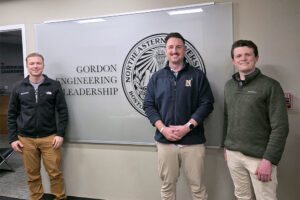
Lincoln Lab currently employs Gordon Fellows Air Force 2nd Lieutenant Simon Gott and Navy Lieutenant Commander Cord Stasolla, both interns in Homeland Sensors and Analytics, Group 45, as well as Matt Avison, an electrical engineer in Software and Electronics Engineering, Group 76.
The Gordon Leadership Certificate Program is offered to a competitive cohort of approximately 40 students each year. The program consists of three courses in leadership, product development, and general engineering that immerse students in mechanical, civil, environmental, electrical, and chemical engineering with weekly projects in each discipline. In conjunction with coursework, all students apply their learning to complete an 11-month ”Challenge Project”, either through a dedicated internship or through full-time employment at a company in the Boston area. It is paired with an extensive, industry-focused thesis that covers technical prowess, marketability, and leadership. Throughout the process, the Gordon Program offers technical and leadership mentorship and support; each student is assigned a faculty advisor from Northeastern, an industry sponsor advocate at their company, and a Gordon Mentor who assist with technical mentorship, operationalizing leadership principles, deadline accountability, and life-coaching to manage the stress of the program and maintain effective time management. At the end of the year, each student defends their project with a 90-minute presentation, culminating in the title of “Gordon Fellow.”
Since 2011, 13 GIEL engineering students have completed their Challenge Project at Lincoln Lab. Daniel Dumanis, Associate Staff, Active Optical Systems, Group 106, was one of the first to participate in the program at Lincoln Lab. Dumanis first joined Lincoln Lab in 2009 as a co-op from Northeastern and was subsequently hired as a full-time staff member. He completed his master’s degree in electrical and computer engineering leadership through Northeastern’s GIEL program.
“For my Challenge Project, I was tasked with the development of a low-cost laser radar (ladar) platform that would allow Lincoln Lab to exploit certain technologies to their fullest potential,” said Dumanis, who has also served as a Gordon mentor for several students enrolled in the program. “Completing this Challenge Project involved building a functional ladar system from a heterogeneous mix of spare parts, installing it on an airplane, performing test flights, and marketing the availability of this new capability. Once I had completed my Challenge Project, the system was used for data collection projects to serve sponsors’ needs in a way that was previously impossible.”
Cord Stasolla
With 10 years of active-duty experience as a Naval officer, Stasolla began his career as a nuclear engineer and later transitioned into cryptologic warfare. He graduated from Lafayette College in 2015 with a degree in mechanical engineering and is now pursuing a master’s degree in data analytics engineering at Northeastern University. At Lincoln Lab, Stasolla is leading a high-visibility Special Operations Command (SOCOM) project with significant national security implications. His work focuses on creating a mesh network of autonomous buoys with onboard sensors to increase maritime domain awareness, providing early warning of potential threats and enabling timely, coordinated responses.
“Especially as a project lead, the leadership principles, models, and frameworks from the Gordon Leadership Program have proven to be highly effective tools and have made me more comfortable in my own shoes, accelerated my learning, and promoted my ability to work collaboratively in teams to achieve positive outcomes as a unit,” said Stasolla.
Simon Gott
Gott began as an enlisted member of the U.S. Air Force and graduated from the Air Force Academy as an active-duty officer in 2025. He has a degree in electrical engineering and is pursuing a master’s degree in advanced manufacturing at Northeastern University. As a military fellow at Lincoln Lab, Gott coordinates and supports Lincoln Lab’s SOCOM Ignite program and Group 45’s unmanned aerial systems efforts. He is currently leading a team that is developing a drone detection system for Army SOCOM, utilizing dismounted acoustic and event-based sensors.
“The Gordon Leadership Program provided key insights into product development and project management and has illuminated key leadership models and scholarship for creating high-performing teams,” said Gott.
Matthew Avison
Avison is working as an electrical engineer in Group 76 while pursuing a master’s degree in communications and controls at Northeastern University. After graduating from UMass Amherst in 2020, he began his career in the defense industry supporting the Terminal High-Altitude Area Defense missile defense program at Raytheon before joining L3Harris Technologies to design submarine sensor platforms. Avison now develops orbital electronics for a special-access space program and recently began leading the design of an acoustic communications module to enable coordination between autonomous undersea vehicles.
“Lincoln Lab is an incredible place for engineers to pursue ambitious ideas, but transitioning from an individual contributor to leading your first proposal can be daunting,” said Avison. “The Gordon Institute’s project-based leadership program is the perfect launchpad to build those skills. The networking and mentorship support systems have been invaluable.”
Across its 15-year history, the partnership between Lincoln Lab and GIEL has continued to develop the next generation of engineering leaders.
“Joining GIEL has many benefits and can help accelerate your career in engineering,” said Stasolla. “The ongoing partnership has been a clear win for both GIEL and Lincoln Lab.”
More information on GIEL and the Gordon Leadership Certificate Program is available on the program’s website or by reaching out to The Gordon Institute at Northeastern’s Director of Admissions, Amy Manley.
Originally published April 17, 2026 in The Bulletin by MIT Lincoln Laboratory.